

Amazon Bedrock is a fully managed, serverless AWS service designed to build and scale generative AI applications. Generative AI has moved from experimental demos to production infrastructure in just a few years. Enterprises now face a familiar dilemma. Which foundation model should they use? How do they deploy it securely? How do they avoid vendor lock-in? Amazon Web Services built Amazon Bedrock to solve exactly that problem. Instead of forcing developers to pick one AI provider and integrate it from scratch, Bedrock offers a single, unified gateway to dozens of leading models. It wraps that access in the security, compliance, and scalability AWS is known for. Here’s a complete look at what AWS Bedrock is, how it works, what it costs, and how businesses use it in 2026.
What Is AWS Bedrock?
Amazon Bedrock (commonly called AWS Bedrock) is a fully managed service. It gives developers API access to high-performing foundation models (FMs) from Amazon and leading third-party AI companies through a single, consistent interface. Businesses don’t need to provision GPUs, manage model infrastructure, or negotiate separate contracts with each AI vendor. They can access, test, customize, and deploy generative AI models directly through Bedrock instead.
Amazon Bedrock became generally available in September 2023. It initially offered a curated set of foundation models. Since then, the platform has expanded dramatically. As of 2026, Bedrock provides access to more than 100 models from 18-plus providers. These models span text, image, video, and multimodal generation.
Here’s the key distinction to understand: Bedrock isn’t a model — it’s a platform. You choose the specific foundation model as a configuration decision. The underlying security, scalability, and observability layer stays constant, and that layer is Bedrock. This means Bedrock workloads inherit AWS Identity and Access Management (IAM), AWS PrivateLink, encryption, and CloudTrail logging by default. That’s a major reason regulated industries — healthcare, finance, government — favor it over calling model providers directly.
AWS Bedrock News: Latest Models and Features (2026)
Amazon Bedrock has expanded rapidly throughout 2026. AWS regularly adds new model providers and platform capabilities. Some of the most notable recent developments include:
- OpenAI models on Bedrock: AWS expanded its OpenAI partnership significantly this year. It began bringing OpenAI’s frontier models — including GPT-5.4, GPT-5.5, and later the GPT-5.6 family (Sol, Terra, and Luna) — to Amazon Bedrock. The Codex coding agent and Bedrock Managed Agents, powered by OpenAI, came along with them. Enterprises can now access OpenAI’s models through the same Bedrock APIs, security controls, and unified billing they already use.
- Grok on Bedrock: xAI’s Grok 4.3 joined Bedrock as a new model provider in mid-2026. It’s a reasoning-first model with configurable reasoning effort and strong tool-use capabilities.
- Gemma 4 on Bedrock: Google DeepMind’s open-weight Gemma 4 family became available on Bedrock. It includes 31B, 26B-A4B, and E2B variants. The family supports reasoning, multimodal input, and function calling across 35-plus languages.
- Claude Opus 4.7: The latest flagship in Anthropic’s Claude lineup arrived on Bedrock with a 1-million-token context window and 128K max output. That’s the largest context window any Claude model offers on the platform to date.
- Amazon Bedrock AgentCore: AgentCore is now generally available. It’s an infrastructure layer that lets teams build and run production-grade AI agents without hand-coding orchestration loops. Teams define an agent’s model, tools, skills, and instructions through configuration instead.
- Bedrock Managed Knowledge Base: AWS introduced this managed retrieval-augmented generation (RAG) capability recently. It simplifies building enterprise knowledge pipelines directly on Bedrock.
This steady cadence of announcements reflects AWS’s strategy. Rather than betting on a single model family, Bedrock positions itself as the neutral infrastructure layer. Enterprises can adopt whichever frontier model fits their needs without re-architecting their stack each time.
Key Capabilities and Features
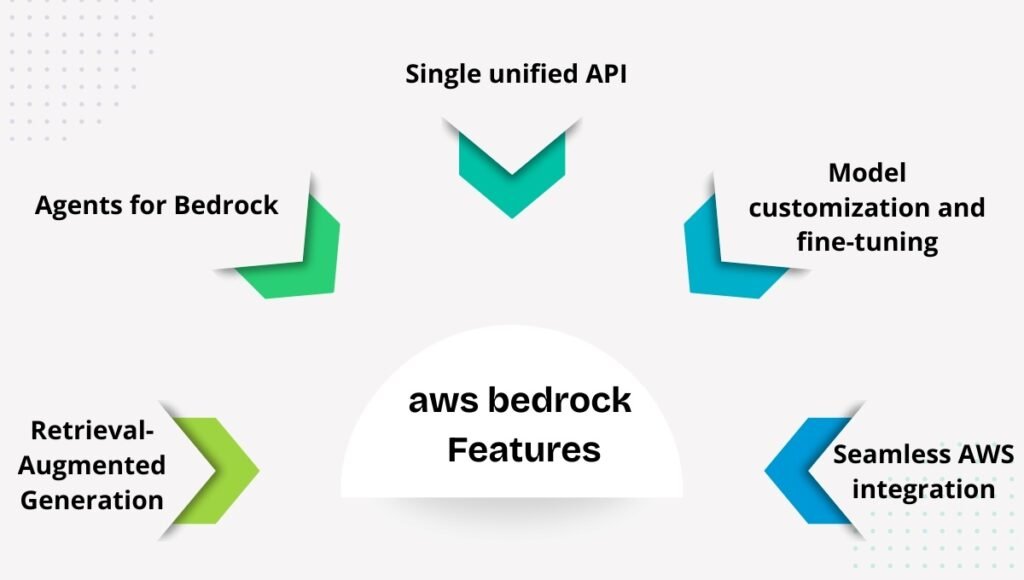
Amazon Bedrock’s feature set takes a business from AI experimentation to production deployment. Core capabilities include:
- Single unified API — You get access to dozens of foundation models from multiple providers through one consistent API. This eliminates the need for separate vendor integrations.
- Model customization and fine-tuning — Developers can fine-tune models with their own labeled data. They can also use continued pre-training to adapt a model to a specific domain or business vocabulary.
- Retrieval-Augmented Generation (RAG) — Bedrock Knowledge Bases let you connect a model to your own documents, databases, or product content. The model retrieves relevant context at query time instead of relying solely on its training data. This significantly reduces hallucinations for business-specific use cases.
- Agents for Bedrock / AgentCore — This managed application layer helps you build autonomous AI agents. These agents carry out multistep tasks, call external tools and APIs, and integrate with third-party agent frameworks like CrewAI and LangGraph.
- Guardrails — These configurable controls include content filtering, denied-topic restrictions, and safety rules. Businesses use them to define what an AI application should and shouldn’t say.
- Security and compliance by default — Bedrock skips data retention for model training and includes encryption, IAM-based access control, and VPC integration. It also supports compliance frameworks such as HIPAA and FedRAMP.
- Seamless AWS integration — Bedrock connects natively to services like Amazon S3, AWS Lambda, Amazon SageMaker, and Amazon CloudWatch. This makes it straightforward to plug generative AI into existing AWS workloads.
- Watermarking and responsible AI tooling — Amazon Titan embeds invisible watermarks in AI-generated images for authenticity and copyright protection. Bedrock also includes tools for evaluating models for bias before deployment.
Supported Foundation Models on AWS Bedrock
Model choice is one of Bedrock’s biggest draws. As of 2026, the platform’s model catalog spans several major AI providers:
- Anthropic Claude — This includes the Claude 4 series, plus the latest Claude Opus 4.7, Claude Sonnet 4.6, and Claude Haiku 4.5. The lineup covers everything from frontier reasoning down to fast, cost-efficient tasks.
- Amazon Nova — Amazon’s own model family includes the established Nova Micro/Lite/Pro line for text, image, and multimodal tasks at competitive pricing. A newer second-generation Nova 2 family (Nova 2 Lite, Nova 2 Pro, Nova 2 Omni) is also available, currently in preview at separate pricing.
- Meta Llama — These open-weight models include the Llama 3.3 series. Teams favor them for cost-effective, customizable deployments.
- Mistral — Models like Mistral Large 2 and Mistral Small aim to balance performance and cost.
- Cohere — These enterprise-focused models, like Command R+, are tuned for retrieval-augmented generation and business search use cases.
- AI21 Labs and Stability AI — These longstanding Bedrock partners offer language and image-generation models, respectively.
- Google DeepMind Gemma 4 — AWS added these open-weight reasoning and multimodal models to the platform in 2026.
- xAI Grok — Grok 4.3 is one of Bedrock’s newest third-party models, built for reasoning-heavy tasks.
- OpenAI — GPT-5.4, GPT-5.5, and the GPT-5.6 family are now available through Bedrock, along with the Codex coding agent. This marks a major expansion of AWS’s model partnerships.
This breadth lets a business route different tasks to different models. A team might use a smaller, cheaper model for classification and routing, then reserve a frontier model for complex reasoning — all without managing separate vendor relationships.
AWS Bedrock Pricing
AWS Bedrock pricing is usage-based. There’s no subscription fee and no guaranteed free tier for production workloads. Pricing generally falls into a few core categories:
- On-Demand pricing — You pay per 1,000 input tokens, per 1,000 output tokens, per image, or per second of generated video. There’s no long-term commitment. This is the default starting point for most teams, and it suits variable or unpredictable workloads well.
- Provisioned Throughput — This fixed, time-based commitment reserves dedicated model capacity for consistent, high-volume workloads. It can lower per-unit costs for predictable traffic, but it requires a term commitment.
- Batch inference — Processing requests in batch generally costs roughly 50% less than on-demand pricing. It fits non-real-time workloads well.
- Prompt caching — AWS bills cached input tokens at a steep discount, up to roughly 90% less than standard input pricing in some cases. This can significantly cut costs for applications that repeatedly send similar context.
On-demand rates per million tokens vary widely by model family. Smaller, efficiency-focused models can cost a fraction of a cent per thousand tokens. Frontier reasoning models command premium per-token rates instead. Beyond core inference, additional charges can apply. These include Guardrails (billed per 1,000 text units evaluated), Bedrock Agents/AgentCore components, Knowledge Base vector storage, and CloudWatch logging.
Important caveat on cost: AWS Bedrock’s published token rates look simple, but real-world bills often run higher than initial estimates. Testing, retries, agent token usage, logging, and Knowledge Base storage all add up. Businesses evaluating Bedrock should build a cost model that accounts for these secondary charges rather than relying solely on the headline per-token price. Always confirm current rates on AWS’s official Bedrock pricing page, since pricing and available models change frequently.
Use Cases for AWS Bedrock
Businesses across industries use Amazon Bedrock to power a wide range of generative AI applications, including:
- Customer service chatbots and virtual assistants that handle support queries using a company’s own knowledge base via RAG.
- Content generation and summarization for marketing copy, product descriptions, and internal document summarization.
- Code generation and developer tooling, especially with coding-focused models and agents like Codex now available on the platform.
- Enterprise search and knowledge retrieval, letting employees query internal documents and data in natural language.
- Image and creative content generation using models such as Amazon Titan and Stability AI.
- Autonomous AI agents that execute multistep business processes — supply chain coordination, hiring workflows, or customer experience automation, for example — using Bedrock AgentCore.
- Regulated-industry applications in healthcare, finance, and government, where Bedrock’s compliance posture (HIPAA, FedRAMP, and similar frameworks) often decides the build-vs-buy question.
Benefits of AWS Bedrock
- Model flexibility — Businesses aren’t locked into a single AI provider. They can choose the best model for each specific task.
- No infrastructure management — Bedrock removes the need to provision GPUs or manage model-serving infrastructure. This significantly lowers the barrier to building generative AI applications.
- Faster time to market — Pre-trained, ready-to-use models let teams prototype and deploy AI features far faster than training models from scratch.
- Enterprise-grade security — Built-in encryption, IAM controls, VPC isolation, and compliance support make Bedrock a strong fit for regulated industries.
- Cost control options — A mix of on-demand, batch, and provisioned throughput pricing gives businesses flexibility. They can optimize cost against workload predictability.
- Deep AWS ecosystem integration — Native compatibility with S3, Lambda, SageMaker, and other AWS services simplifies building complete, end-to-end AI-powered applications.
Limitations to Consider
- Cost unpredictability at scale — The per-token pricing model looks simple, but real-world costs from testing, retries, logging, and agent token usage can push actual spend well above initial estimates.
- Model availability lag — New models from partners like OpenAI and Anthropic sometimes reach Bedrock a few weeks after their direct-API release. Teams needing day-one access to the newest model may need to look elsewhere first.
- Regional availability — Not every model or feature is available in every AWS region. This can constrain globally distributed applications or workloads with strict data-residency requirements.
- Learning curve for advanced features — Basic model access is straightforward, but capabilities like Agents, Knowledge Bases, and Guardrails carry their own configuration complexity. They require dedicated learning time.
- No reliable free tier for production — Bedrock is usage-based with no ongoing free allocation suitable for production traffic. Cost planning has to start early.
How Businesses Can Build Generative AI Applications with Bedrock
Getting started with Amazon Bedrock typically follows a similar path for most teams:
- Access the Bedrock console — Log in to the AWS Management Console and navigate to the Bedrock dashboard.
- Request model access — Enable access to the specific foundation models you plan to use. Many newer serverless models are enabled by default already.
- Experiment in the playground — Test prompts and compare model outputs directly in the console before writing any code.
- Connect your data — Set up a Knowledge Base to enable RAG for business-specific applications, so the model can reference your own documents and data.
- Customize if needed — Fine-tune a model with your own data if off-the-shelf performance doesn’t meet your requirements.
- Add guardrails — Configure content filters and denied-topic rules appropriate for your use case and industry.
- Integrate and deploy — Connect Bedrock to your application via its unified API. Pair it with services like Lambda (for serverless compute) and S3 (for storage), then move from provisioned testing to production traffic.
- Monitor and optimize — Use CloudWatch and Bedrock’s usage reporting to track cost and performance. Adjust between on-demand, batch, and provisioned throughput pricing as usage patterns stabilize.
Conclusion
Amazon Bedrock has evolved fast. It launched in 2023 with a curated set of six foundation models. Today, it’s one of the most model-diverse generative AI platforms available, spanning Anthropic, Amazon, Meta, Mistral, Cohere, Google DeepMind, xAI, and OpenAI. Its core value proposition stays simple: one unified API, enterprise-grade security, and no infrastructure to manage. That proposition has made it a default choice for AWS-native businesses building generative AI applications, particularly in regulated industries. AWS keeps expanding its model catalog and agentic capabilities like AgentCore. As a result, Bedrock is becoming less of a single AI product and more of a control plane for how enterprises adopt generative AI.
Frequently Asked Questions (FAQs)
A1. Businesses use AWS Bedrock to build and scale generative AI applications — chatbots, content generation tools, enterprise search, and autonomous AI agents — without managing the underlying model infrastructure.
A2. No. Teams use SageMaker to build and train custom machine learning models from the ground up. Bedrock instead gives developers API access to pre-trained foundation models for generative AI applications.
A3. As of 2026, Bedrock offers more than 100 models from 18-plus providers. These include Anthropic Claude, Amazon Nova, Meta Llama, Mistral, Cohere, AI21 Labs, Stability AI, Google DeepMind’s Gemma 4, xAI’s Grok, and OpenAI’s GPT-5 series.
A4. Bedrock uses usage-based pricing with on-demand (pay-per-token), batch (roughly 50% cheaper), and provisioned throughput (fixed commitment) options. Actual costs vary widely by model choice and usage volume. Additional charges apply for features like Guardrails, Agents, and Knowledge Base storage.
A5. Bedrock doesn’t offer a reliable free tier suitable for production workloads. It’s a usage-based service from the start, though light console experimentation can involve minimal cost.
Also Read: Claude Cowork: The Complete Guide to Anthropic’s AI Work Agent