

Synthesia AI is an artificial intelligence platform that generates synthetic human imagery and video with associated labels for computer vision model training. Instead of relying solely on real-world data capture and annotation, developers can leverage computer graphics to generate synthetic data for AI training. Synthesia AI is suitable for computer vision and machine learning teams and enterprises in the fields of facial analysis, human pose estimation, augmented reality, virtual reality, identity verification, and computer vision applications, among others. The technology can facilitate training data acquisition and alleviate some challenges of using real-world datasets to train machine learning algorithms.
This article discusses Synthesia AI’s features, use cases, pricing, alternatives, benefits, limitations, and applicability in 2026.
What is Synthesia AI?
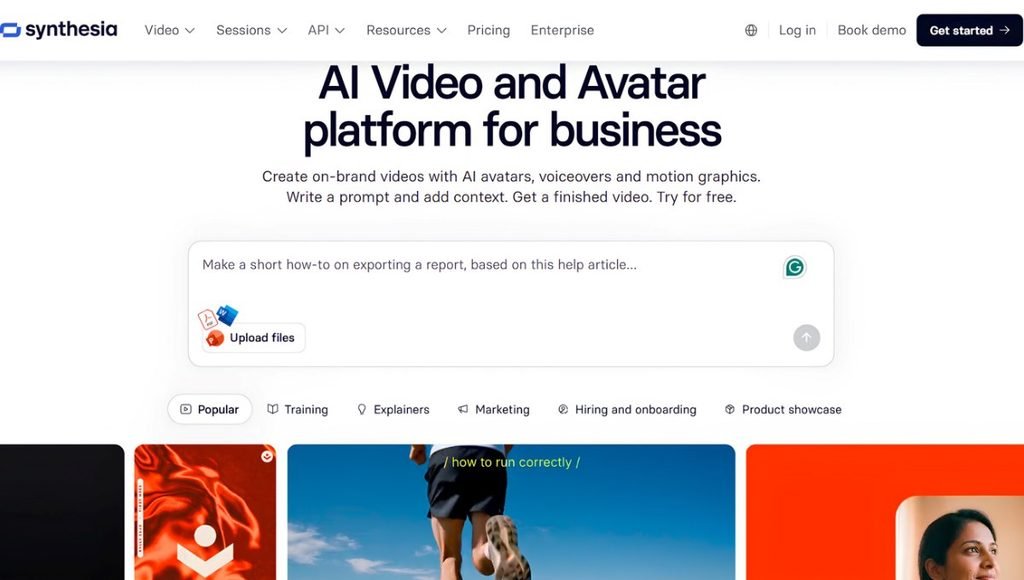
Synthesia AI is a synthetic data generation platform that enables enterprises to design and build computer vision and machine learning applications. The technology makes it possible to produce realistic computer-generated imagery and video for model training, using computer graphics and related tools.
Conventional machine learning algorithms rely on photos and videos acquired from real-world sources. Taking and storing photographs and videos can be expensive, time-consuming, and sometimes impractical. Synthetic data generation aims to overcome these limitations by capturing artificial examples that can be annotated to support computer vision applications.
For instance, developers working on human pose-estimation algorithms can use synthetic data capture and generation to design an extensive dataset that includes various poses, lighting conditions, clothing, and backgrounds. In contrast, acquiring photographs of all these variations would be impossible, prohibitively expensive, or excessively time-consuming.
Key Features of Synthesia AI
Synthesia AI is a synthetic data generation platform that enables developers to create realistic computer vision data sets. The technology is instrumental in helping computer vision engineers and roboticists acquire diverse data examples for model training, annotate images and videos, and access virtual examples that might be impractical to capture using conventional data capture methods. Here are the leading features of Synthesia AI:
Synthesia of High-Quality Human Imagery
One of the critical features of Synthesia AI is its ability to generate high-quality synthetic human imagery. Developers can leverage these realistic computer vision examples to train facial identification and computer vision algorithms to detect and analyze faces and human characteristics.
In particular, the deep learning model can be used to create extensive data sets that contain various human appearances, postures, lighting conditions, and backgrounds. The tool helps computer vision engineers and roboticists generate extensive and diverse data sets that reflect the real world.
Facial Data Generation
Synthesia AI makes it possible to generate synthetic facial data that can be instrumental in developing computer vision applications. Facial data sets are crucial in training algorithms to detect and analyze human faces and characteristics.
As such, Synthesia AI can be used to augment facial recognition data sets and support the development of machine learning applications in the fields of human pose estimation, computer vision, and augmented and virtual reality.
Generation of Data Sets with Annotations
Training machine learning algorithms requires annotated data. Most conventional data sets require developers to manually label and annotate images, which is a time-consuming process.
Synthesia AI can be used to generate comprehensive data sets that come with annotations. The computer vision platform can be instrumental in creating annotated data sets, particularly facial landmark annotations, body pose annotations, and other computer vision-specific annotations.
Generation of Diverse and Customized Data Sets
A lack of diverse datasets reflecting varying lighting conditions, appearances, and other factors limits many computer vision algorithms. Synthesia AI enables developers to create diverse, customized datasets to train computer vision algorithms and test their performance.
Privacy Preservation
One of the significant benefits of Synthesia AI is its potential to prevent the use of real-world photographic data sets to train computer vision algorithms. As such, the technology can be instrumental in helping enterprises adhere to data privacy regulations and reduce the risks of using real-life images and videos to capture data sets.
Applications in Computer Vision
Synthesia AI is designed to support computer vision applications in the fields of facial analysis, human pose estimation, augmented reality, virtual reality, driver monitoring systems, and virtual try-on solutions. The computer vision platform can facilitate the development of machine learning algorithms that can operate in augmented reality, virtual reality, and other computer vision applications.
Tools and Technologies
Synthesia AI is primarily a synthetic data generation platform that enables enterprises to capture extensive training data sets for computer vision applications. Unlike general-purpose AI platforms, such as Midjourney and Jasper AI, Synthesia AI focuses on leveraging computer graphics to generate realistic examples of people’s faces and bodies. In particular, the technology can be used to create labeled and annotated data sets that can be used to train computer vision algorithms.
| Tool or Capability | Main Purpose |
| Synthetic Human Generation | Creates artificial human images for AI training |
| Facial Data Generation | Supports facial analysis and biometric model development |
| Human Body Data | Helps train models that interpret human appearance and pose |
| Dataset Customization | Supports specialized training data requirements |
| Image and Video Simulation | Helps generate visual examples for computer vision |
| Data Annotation | Provides labels and spatial information for generated data |
| Diversity Controls | Supports variation across visual characteristics and environments |
| Edge-Case Generation | Helps cover uncommon or difficult scenarios |
| Privacy-Focused Data Workflows | Reduces reliance on identifiable real-world images |
| Computer Vision Dataset Development | Supports the preparation of specialized AI training datasets |
Note: The availability of particular controls, formats of resulting datasets, types of annotations, and generation options depends on the products’ configuration and a commercial arrangement. It should be confirmed with the vendor prior to purchase.
How to Use Synthesia AI
Synthesia AI is primarily designed for developers and organizations that want to build computer vision solutions. The particular process depends on the selected plan and technological capabilities offered by the vendor. In general, it contains the following steps:
Initial Planning & Setup
Step 1. Visit the Official Webpage
The first step is to visit the official Synthesia AI webpage and learn the key benefits and features of the product.
In this stage, users should understand whether the computer vision platform is suitable for their intended application and project’s complexity level.
Step 2. Define Project Requirements
Before using the online tool to design synthetic data, define the intended use case for your computer vision project.
For example, you may need to build a solution for facial landmark detection, a driver-monitoring system, a real-time try-on experience, or a human pose estimator. All these use cases have specific requirements, so it is essential to clarify the details and prepare a list of necessary visual attributes.
Step 3. Contact the Vendor
Since Synthesia AI is primarily an enterprise-level solution, you may need to contact the vendor’s support team and explain your use case and requirements in detail. You should also ask about available plan options and discuss the expected budget and scale.
Configuration & Execution
Step 4. Prepare a Set of Requirements
Once your request has been reviewed and approved, you will receive access to the platform and begin preparing a set of requirements. The actual parameters depend on the selected plan, but the general idea is to identify visual elements associated with your project.
It may also include specific attributes related to human appearance, poses, lighting, environment, and other factors.
Step 5. Use the Software to Design Synthetic Data
The next step is to use the selected tool to design synthetic data and visuals that will be used as a basis for your computer vision project.
Step 6. Review Visual Elements and Annotations
At this point, you should review annotations and visual elements to ensure there are no issues with quality and variation. Make sure that all elements are relevant to your use case and can provide enough training data for your project.
Step 7. Train the Model and Test Its Performance
The last step is to train a model and test its performance on a separate set of real-world data. If the results are not satisfactory, consider improving the quality of annotations and synthetic data or supplementing them with real-world examples. It is crucial to understand that realistic annotations and visuals are not enough for successful
computer vision training.
Synthesia AI Pricing Plans
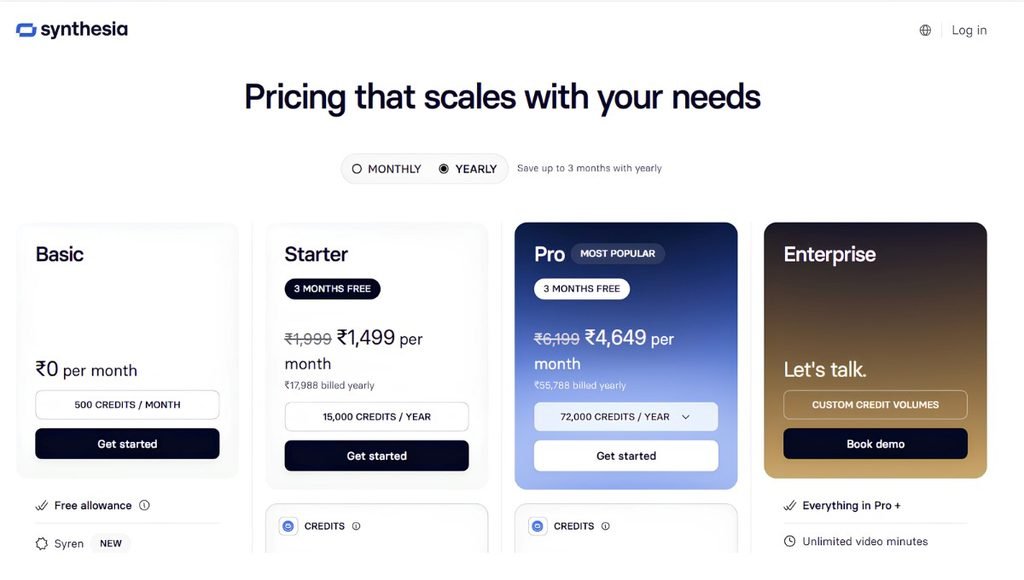
Pricing-wise, you should remember that Synthesia AI is an enterprise-level computer vision platform and not a consumer-level tool. As such, it has different plans and options that should be discussed directly with the vendor.
| Platform | Free Plan | Paid Pricing | Billing Type | Best For |
| Synthesys AI | Availability depends on the current offer | Starter: $29/month; Pro: $59/month; Agency: $119/month; Max: from $199/month | Monthly or annual | AI videos, voiceovers, and marketing content |
| Synthesia | $0/month | Starter: around $29/month; Creator: around $89/month | Monthly or annual, depending on plan | AI avatar videos, presentations, and training |
| Synthesia Intelligence | 14-day free trial | $999/month | Subscription | Business intelligence and decision-making |
| Synthesia AI | Depends on the program | Reported offers around $1,995–$2,999 | One-time payment or program-based | Digital products and online courses |
| Synthesia AI | No standard public free plan confirmed | Custom enterprise pricing | Custom contract | Synthetic data and computer vision |
Synthesia AI vs Competitors
Synthesia AI operates in a specialized market where different platforms serve different computer vision requirements. Some focus on human-centric datasets, while others provide broader simulation environments for robotics, autonomous vehicles, and industrial AI.
| Feature | Synthesia AI | NVIDIA Omniverse | Rendered.ai |
| Primary Purpose | Human-centric synthetic data | 3D simulation and synthetic data | Enterprise synthetic data generation |
| Human Image Generation | Core application area | Possible through custom workflows | Depends on configuration |
| Robotics Support | Application-dependent | Strong focus | Supported through custom workflows |
| Data Annotation | Supported dataset capabilities | Configurable annotators | Automated annotation capabilities |
| Customization | Specialized data requirements | Extensive simulation customization | Custom generation workflows |
| Pricing | Contact provider | Varies by product and deployment | Subscription or custom pricing |
| Best For | Human-centric computer vision | Robotics and physical AI | Enterprise computer vision projects |
Applications of Synthesia AI
Synthesia AI can benefit various industries that rely on accurate human-centric computer vision models such as:
Identity verification
Systems utilize computer vision to identify and recognize whether a particular person matches the provided data. Synthetic facial data can help developers and researchers to explore the possibilities and challenges before testing their models on the production data. However, the production application must be tested using representative samples to understand the accuracy and evaluate model performance across different groups of people.
Security and Surveillance
Security applications may utilize computer vision to identify or recognize people, as well as detect and track activities in a particular area. Synthetic data can help in exploring and analyzing multiple scenarios, perspectives, and behaviors. Moreover, some uncommon cases might require additional examples that would be hard to find during the regular data collection process.
Augmented and Virtual Reality
Both augmented reality (AR) and virtual reality (VR) applications require computer vision to be able to recognize facial expressions, body posture, and other visual aspects to create realistic experiences. With a combination of synthetic human images and 3D annotations, developers can train their models to be able to identify and recognize all the key features of a human. These computer vision models may be used in various applications related to AR, VR, and human-computer interaction.
Automotive and Driver Monitoring
Computer vision is widely used by automotive applications to recognize and understand the driver’s activities and intentions. Synthetic data can be used to explore multiple lighting conditions, camera positions, appearances, and other factors. This information can be used to improve and test the model before it is deployed on actual cars.
Virtual Try-On and Retail Technology
Virtual try-on applications rely on computer vision to estimate the person’s posture, body posture and shape, and recognize clothing items, accessories, and other visual aspects. Synthetic data can help in generating multiple use cases that can be utilized for training and testing computer vision models in different poses, body shapes, and clothing styles.
Who Should Use Synthesia AI?
AI and Machine Learning Engineers
People who develop computer vision models can consider using the Synthesia AI service when they need large-scale representative data for training or testing purposes.
Computer Vision Researchers
Researchers working on projects related to facial analysis, human pose detection, or similar computer vision tasks can benefit from using this synthetic data generation service.
Automotive Technology Companies
Firms working on driver monitoring, passenger monitoring systems, or different automotive applications can utilize this solution to explore and develop their computer vision models.
AR and VR Developers
Developers and researchers in the fields of augmented and virtual reality can consider using such a solution to create computer vision models related to body posture tracking, visual understanding, and other tasks.
Biometric Technology Companies
Firms working on facial verification, biometric recognition, and similar technologies can explore this data generation platform to build and test their model. However, remember that proper validation is required before deploying such solutions to make sure that they are not biased toward any particular race or gender.
Enterprise AI Teams
Companies and enterprises that need high-quality data at scale can consider using this solution to see whether investing in a commercial-grade synthetic data generation platform makes sense. The Synthesia AI synthetic data platform provides a number of features that enterprise teams should explore, including automated data labeling solutions.
Students and Individual Developers
Students and individual developers who want to learn how computer vision works can benefit from being familiar with synthetic data generation platforms.
Conclusion
Synthesia AI is considered to be a specialist in the field of synthetic data generation and computer vision model development. The benefits of this particular solution include control over the appearance of different objects, accurate annotations, the ability to avoid some of the challenges associated with collecting actual images, and others. Some of the areas that can benefit from using this solution include identity verification, video surveillance and security, augmented and virtual reality, automotive and driver monitoring, and virtual try-on applications. However, whether or not this solution is right for you depends on your specific needs and circumstances.
FAQs About Synthesia AI
A1. Synthesia AI is a powerful synthetic data generation platform that can be utilized in a variety of different computer vision applications, including facial recognition, identity verification, driver monitoring systems, AR/VR applications, virtual try-on solutions, and others.
A2. This synthetic data generation platform is most likely not ideal for most beginners, especially those who are just getting started with machine learning and computer vision.
A3. If you are looking for a viable alternative in the fields of robotics and 3D simulation, NVIDIA Omniverse is definitely worth your consideration. As for other computer vision applications, Rendered.ai is one of the best alternatives on the market.
Also Read: Pieces AI: Features, How to Use, Pricing, Pros and Cons (2026)