

Futuristic technology concept that has caught the eye of the internet, Apple Teleport has been put forward as a technology that could allow Apple to transmit objects or people from one place to another in a flash. It’s like what happens in science-fiction films when a person walks into a machine and emerges at a different location practically instantly. But, it should be noted that the concept of Apple Teleport is separate from Apple’s officially announced products. No official announcement has been made by Apple for Apple Teleport, a consumer friendly teleportation device, or a machine to physically teleport humans as of September 2026.
What is Apple Teleport?
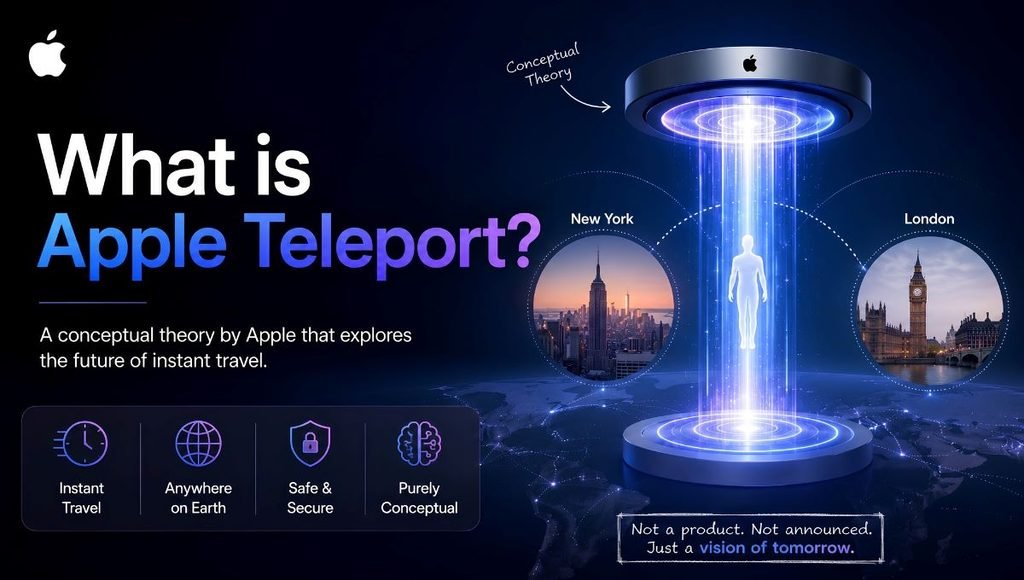
Apple Teleport is a concept that refers to an unofficial futuristic technology of instant transport or extremely realistic remote presence that is associated with the apple company. Its most radical application is that Apple Teleport would make it possible for an individual to move from one place to another without relying on a vehicle, train or plane. In theory, a user can be able to enter a teleportation system, choose a destination and suddenly be there. Another reading is more closely related to known technology. Instead of picking up a person, an Apple Teleport-type of system could create another location virtually with the help of spatial computing, virtual reality, augmented reality, 3D imaging, artificial intelligence, and immersive audio. The second is a more realistic concept due to the fact that many of the technologies are already in existence.
Is Apple Teleport Real?
No Apple Teleport device has been confirmed as yet. There hasn’t been any announcement by Apple about such a product and no physical device has been shown to move humans from one place to another for commerce.
Readers should take rumors of an Apple Teleport machine with a pinch of salt. Creators easily produce viral videos and futuristic product renders using CGI, artificial intelligence, and video-editing tools. Their presence is not indicative of the technology’s existence.
The idea behind Apple Teleport
The Apple Teleport idea can be divided into two major categories.
Physical Teleportation
Physical teleportation is the science fiction concept of transporting a man, woman or object from place to place without regular transport. For instance, an Indian citizen might be able to be teleported to the United States virtually instantaneously by using a teleportation machine. There isn’t a feasible way to teleport humans with the current science.
Digital Teleportation
Digital teleportation is a more plausible idea. Rather than physically relocating the body, technology alters the digital world of the user, making him or her feel “at another place.” One of the future visions of the spatial computing system would be to recreate a remote place in 3D and interact with it by eye, hand and voice. This may make one feel like they are in a different location even though their body is not.
Technology Behind a Future Apple Teleport
If Apple had to launch a Teleport product, there are a number of new technologies that would need to be developed.
Spatial Computing
Spatial computing involves integrated the use of digital information and three-dimensional physical surroundings.
Apple Vision Pro ecosystem showcases the positioning and interaction of digital objects in a user’s environment. Future spatial-computing systems could provide much more realistic remote environments.
Augmented and Virtual Reality
Augmented reality puts digital content into the real world and virtual reality puts a user into a virtual world. The use of these technologies could enable the user to explore detailed virtual representations of locations far away.
3D Environment Capture
Using cameras and sensors, future systems can transform physical environments into 3D digital models and deliver rooms, landmarks, or offices to remote users.
Spatial Audio
In order to develop a believable sense of place, sound is crucial. Spatial audio can help to make sounds sound like they are coming from a specific direction or distance. When combined with realistic visuals, it can create a more natural experience for a virtual environment.
Artificial Intelligence
AI might be able to analyse vast amounts of visual and spatial data and contribute to the creation of realistic environments. It can also fill in missing information, enhance images, produce digital versions of people and now allow for natural interaction in a virtual setting.
High-Speed Connectivity
Engineers need ultra-fast, reliable networks to build realistic remote-presence systems. These systems tolerate almost zero latency while streaming heavy loads of visual, spatial, and audio data.
Apple Teleport and Apple Vision Pro
Apple Vision Pro is one of the most pertinent real technologies when it comes to the future of Apple Teleport. Vision Pro should not be considered a teleportation device. Rather, it takes advantage of spatial computing to generate immersive experiences for the user. The technology shows an example of how a user can manipulate digital content in 3-D, instead of just viewing it on a flat screen. Eventually, new “spatial devices” may offer more and more realistic remote-presence experiences. Users can virtually visit a different place, meet other people and explore recreatations of real places in the virtual world. The person stays in the same location but it may seem like teleportation to them.
Apple Teleport and RealityKit
RealityKit is Apple’s framework for developing augmented-reality and spatial experiences. That’s partly why the term “teleport” crops up in some Apple tech talk about the product – RealityKit offers capabilities to move virtual characters around in a digital space. This kind of teleportation is completely software based. It simply refers to the ability of a digital character to jump from one place to another in an application. That doesn’t imply Apple created technology that lets them physically teleport people. Anyone researching Apple Teleport must note this distinction, because readers easily misunderstand technical teleportation references.
Apple Teleport and Virtual Movement
Teleportation is already employed in other virtual and immersive applications as a way to move. Users do not need to physically move around a large virtual environment, but can choose a different point and instantly “walk” their virtual viewpoint to that point. The strategy may be helpful in VR as it minimizes physical movement and can assist the user with navigating in large virtual environments. Apple’s spatial computing capabilities can contribute to the immersive applications with movement and interaction that occurs within virtual or augmented space.
Potential Applications of Apple Teleport
In years to come, if apple or another technology firm has the ability to create advanced teleport-like technology, it could have uses in a variety of industries.
- Virtual Travel. Users could visit renowned places, museums, cities and natural environments without having to go anywhere. A comprehensive 3D space might give a more realistic impression than traditional photos or videos.
- Education. Students could tour virtually historical places, labs, museums, space environments and other learning destinations. Complex concepts could be explained in an interactive manner through immersive environments by teachers.
- Remote Work. Creating a teleport-like spatial system could help make remote meetings more immersive. Instead of appearing in tiny video-call tiles, participants interacted inside a shared 3D space.
- Healthcare. Advanced 3D and spatial technologies can replicate medical scans and models, helping doctors collaborate from anywhere. But for medical uses, there would be privacy, security and regulatory restrictions.
- Entertainment. Films, games, concerts and sporting events might turn into much more immersive. Users can also be ‘in’ an event rather than just ‘observing’ it, from a virtual environment.
- Tourism. Travel companies may offer customers a virtual tour of locations prior to travel. This may be beneficial to those who are unable to travel freely over great distances.
- Real Estate. Potential buyers might browse with extensive 3D environments. Realistic virtual walkthroughs could give much more information than conventional photographs.
- Engineering and Design. Engineers and designers could come together around detailed 3D models of buildings, vehicles, machines and other products.
Apple Teleport Patent Context
Another reason for futuristic Apple technology claims becoming confusing is patents. Apple has been applying for patents and patent applications focusing on hardware, software, displays, sensors, spatial computing, interfaces and other technologies on a regular basis. But having a patent does not necessarily imply that there is a commercial product. A patent is a protection for an experimental idea, a technical solution, a potential future feature or an invention that may not be available to the public.
So, if it’s an Apple patent with regards to spatial computing, immersive displays or 3D environments, that does not automatically mean it’s a patent for Apple Teleport.
Does Apple Have a Teleportation Patent?
No evidence that Apple has patented a consumer device that physically transports humans. Apple has a significant IP portfolio related to future technologies, such as spatial computing and immersive interfaces. Although these technologies could power future “remote-presence” tools, they do not equal physical “teleportation.” If someone claims that Apple has patented teleportation, it’s crucial to look at the patent and see what kind of technology it covers. Patents covering virtual movement, 3D environments, and spatial interfaces do not represent physical transport solutions.
Latest Apple Teleport Information in 2026
As of September 2026, no official announcement of an apple teleport machine is made. The technology development that is visible to the public, through Apple, is instead on things like artificial intelligence, spatial computing, visionOS, Apple Vision Pro, and immersive software experiences. Apple is continuing to build out the potential of its spatial-computing toolbox, providing the developers with some of the tools to build 3-D apps and experiences.
The company’s ongoing development of AI may also impact the future realm of spatial applications, especially with the enhancement of the understanding of the environment, creation of content, digital assistants and real-time interactions. While these developments advance the broader concept of digital teleportation, readers should not view them as proof that Apple is building an actual teleportation machine.
Apple Teleport vs Virtual Teleportation
| Feature | Physical Apple Teleport | Virtual Teleportation |
| Moves a physical person | Hypothetical | No |
| Official Apple product | No | Possible through software |
| Requires physical travel | No, theoretically | User remains in place |
| Uses 3D graphics | Potentially | Yes |
| Uses spatial computing | Potentially | Yes |
| Uses immersive environments | Potentially | Yes |
| Available today | No | Yes, in various applications |
| Connected with Vision Pro | Speculative | Yes, conceptually |
| Scientific status | Not currently possible | Existing technology |
Why Apple Teleport Is Trending
The success of Apple Teleport is the result of a few strong forces. These two are synonymous to futuristic consumer technology and one of the most recognized concepts in science fiction is teleportation. Generative AI has also simplified the process of generating realistic product images and videos. A fictional device can be created, hardware as minimal as possible, interface as futuristic as possible, and realistic demos as possible. The content can then be spread further via social-media algorithms. This can lead to the repeated encounter by the user of the same fictional concept and the belief that it is a real product.
Are Apple Teleport Videos Legitimate?
Not necessarily Photos and videos of people seemingly disappearing and reappearing are easily made. CGI, visual effects or generative AI can be used for more sophisticated videos.
Even with a stationary camera and the use of jump cuts, a teleportation effect can be produced. Person exits the scene, recording ceases, person moves and recording takes place again. The clips when joined together seem to show that person moving from one place to another in a split-second.
So, if Apple has truly made an actual teleportation machine, an online video will not be enough proof.
Advantages of Teleport
- May enhance remote experiences.
- May decrease the necessity to travel physically to some extent.
- Would enhance the ability to work collaboratively remotely.
- Potentially change the way education and training are provided.
- Could design new types of amusement.
- May facilitate virtual travel.
- Could enhance 3D design and engineering processes.
- May help to make remote communication more natural.
Limitations and Challenges
- As of yet, it is not possible for human beings to be teleported.
- Significant scientific advances would have to be made.
- It would be a huge technical challenge to reconstruct a human body.
- One of the likely areas of concern would be privacy and security.
- A high quality immersive environment requires a lot of computing power.
- Extremely low-latency connectivity would be important.
- Ethical and legal aspects would have to be considered.
- A patent would not assure a completed consumer product.
Future of Apple Teleport Technology
More likely, the future of Apple Teleport will be digital teleport, remote presence, rather than physical transport, than moving into the future. Apple’s current investment in spatial computing offers a base for scenarios where users can interact with virtual representations of faraway places. Future devices might be even smaller, lighter and more powerful. Advancements in the display, camera, sensor, AI, networking, and spatial audio technologies could bring virtual worlds closer to reality.
One user could sooner or later be able to virtually visit another office, attend a concert, visit a museum, or meet another person in a shared three dimensional space. While not technically “teleportation,” the experience might be near enough to the science fiction concept that users may call it “teleporting.
Conclusion
At this time, Apple Teleport is not a product announced by Apple, but a futuristic idea. There is no known Apple machine that can physically teleport humans, nor is there an official price or release date for Apple Teleport. It is still linked to a number of real elements of Apple’s technology efforts. A range of other technologies, including spatial computing, Apple Vision Pro, visionOS, RealityKit, immersive audio, and artificial intelligence and 3D environments, might all play a role in future remote-presence experiences. Teleportation language is another source of confusion in virtual worlds, such as Apple’s. No two ways around it, moving a digital character instantaneously inside a virtual world is far simpler than moving a physical person.
FAQs
A1. Apple Teleport is a future concept that can be said to be unofficial, in the context of instant transportation or immersive digital experience. There isn’t a product of this name as announced by Apple yet.
A2. There is no available proof of a real Apple Teleport device in September 2026.
A3. No one can prove publicly that Apple has built a machine that can physically teleport people.
A4. No evidence of any patent for a human-teleportation machine for consumers has been found. Patents for Apple’s spatial and immersive technologies don’t necessarily have to be called teleportation patents.
Also Read: COCOMO Model: Definition, Types, Formula, Advantages, Limitations and Applications