

Chatgpt 4 is one of the largest language models developed by OpenAI’s Generative Pre-Trained Transformer (GPT) technology. It was designed to grasp written instructions and produce meaningful responses which closely reflect the user’s needs.
The model can process information, reply to queries, compose written material, describe things, guide the programming process, summarize lengthy texts, interpret texts in another language and be used to solve various problems. It could be particularly useful for professional and education uses, due to its superior capacity to adhere to complex instructions. The initial API for GPT-4 had a 8,192-token context window, and a larger version with a 32,768-token context window was also released for some applications. This enabled GPT-4 to process much more data than previous versions. GPT-4 was instrumental in showcasing the potential of language models in practical applications such as business processes, education, developer tools, customer service, and other software applications.
Key Features of Chatgpt 4
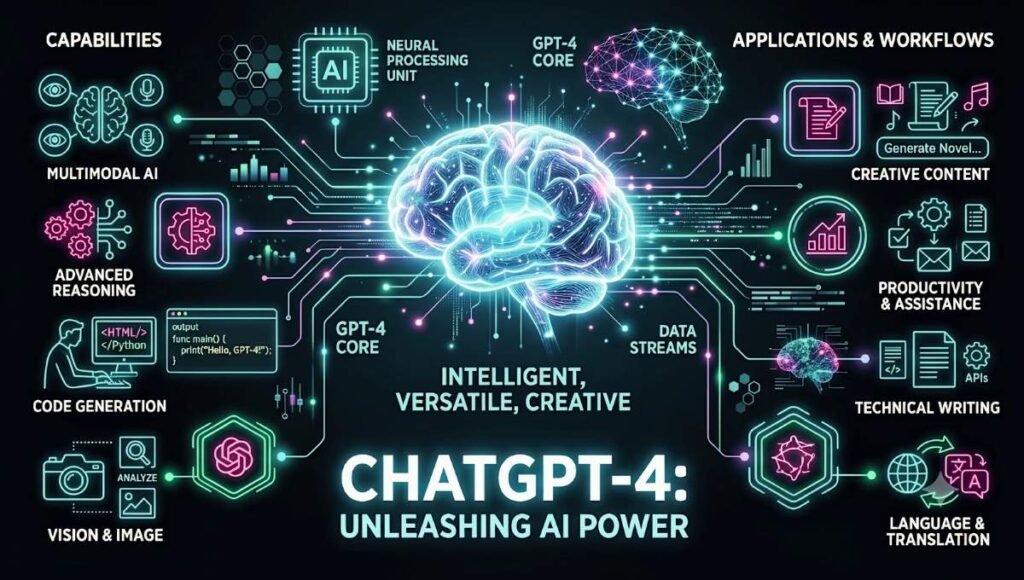
- Advanced Language Understanding: GPT-4 is capable of comprehending natural-language questions, long instructions, and context. This makes it possible to interact with it via natural language, rather than by using specialised commands.
- High-Quality Content Generation: Specific uses of the model include creation of articles, essays, emails, reports, product descriptions, summaries, scripts, and other written material. Can also modify existing text with various tones and requirements.
- Coding Assistance: GPT-4 can create programming code and explain the code already written by programmers. It can also help you to debug, find any possible problems, describe programming concepts and offer possible improvements.
- Reasoning and problem solving class: GPT-4 is more powerful than many of its predecessors in terms of its reasoning abilities. It can solve mathematical, logical, analytical, and knowledge-based problems, but users must still verify the results in significant applications.
- Multilingual Capabilities: GPT-4 is able to comprehend and produce text across a wide range of languages. It is helpful in translation, intercultural or communication work and language learning, and multilingual content production.
- Context Awareness: GPT-4 can reference what it has learned from earlier points in a chat to provide relevant responses. It has the context capabilities, which mean that users can give instructions, background information, and follow-up questions without repeating all of this.
- Versatile Applications: GPT-4 has a wide range of applications and capabilities. The versatility of its design makes it the ideal choice for both individuals and organizations in the process of creating AI-powered applications.
How to Use Chatgpt 4
Here is a step wise method to use Chatgpt 4.
- Step 1: Choose GPT-4. Use a platform or application that makes the GPT-4 model available, or have it available via an appropriate OpenAI API when it is available.
- Step 2: Write the clear prompt in chat box. Describe precisely what you tell GPT-4 to do. Cover key elements including subject, required format, length, target audience, tone/voice and special requirements.
- Step 3: Make sure to give any important details. Provide a model with background information for the task. If you’re asking to summarize, include the appropriate document or text.
- Step 4: Read the Response. Check the solution you have obtained before applying it. GPT-4 may generate incorrect or outdated information, and critical facts, calculations, references and professional advice must be verified by other means.
- Step 5: Revise the Prompt. If the answer is not to your satisfaction, give further directions. You can adjust the requirements of GPT-4 by making the required answer shorter, more detailed, simpler, more professional, or more organized.
- Step 6: Use the Final Output. Once the response has been reviewed and improved, the content can be added to your project, document, application, research, educational work or business workflow.
Applications of Chatgpt 4
- Content Creation: GPT-4 is useful for creating blog posts, articles, social-media content, advertisements, product descriptions and more.
- Education: Students and teachers can use GPT-4 to clarify complex topics, create study materials, generate practice questions, summarize coursework, and support language learning.
- Software Development: Developers can use the model for code generation, debugging, documentation, programming explanations, and development support.
- Customer Support: Language models can be incorporated into customer-service systems to handle typical inquiries and give automatic assistance.
- Research and Analysis: GPT-4 can summarize information, arrange research notes, compare concepts, extract key points, and clarify complex content.
- Translation: The model can be used to translate and adapt from one language into another, while maintaining the gist of the message and context of the material.
- Business Operations: GPT-4 can assist organizations in several different ways, such as in writing emails, generating reports, analyzing text, producing internal documents and automating repetitive tasks in a language-based way.
- Creative Work: GPT-4 can assist writers and creators with brainstorming ideas, character development, outlining their work, and trying out various writing styles.
Chatgpt 4 Pricing
The cost of using Chatgpt 4 API varies with the model and method of access. The initial API pricing for the OpenAI’s GPT-4 was comparatively high compared to numerous latest models, rendering it less appealing for big-volume actions. The initial cost of using GPT-4 was $30 per one million input tokens and $60 per one million output tokens. Prices and availability of models may change over time, and users should refer to OpenAI’s official documentation to determine which models are available for a specific application.
Typically, pricing for developers depends on the number of tokens that are processed. The input tokens are used to pass information to the model, and the output tokens are used to retrieve information from the model. The real costs will thus vary according to prompt length, response length, traffic and the selection of a model.
Advantages of Chatgpt 4
- Excellent language understanding — It can effectively understand instructions written in natural language.
- Multi-function performance — It can perform writing, coding, educational, research and business functions.
- Better reasoning capabilities — It can solve many more complex problems than previous GPT models.
- Multilingual support — It can work with numerous languages and translation tasks.
- Extensive adoption — GPT-4 has been heavily adopted into AI products and processes.
Limitations of Chatgpt 4
- Older model generation — newer model OpenAI models tend to have better capabilities.
- Older models have more context — A second-generation context window is significantly larger than the original.
- Expensive costs for some workloads — At first it had a pretty high API pricing. The possibility of errors — GPT-4 is prone to generating false or misleading information.
- Inadequate and outdated modern functionality — More advanced reasoning capabilities, tools, structured outputs and multimodal are available in newer models.
Chatgpt 4 vs Newer Models: Quick Comparison
| Feature | GPT-4 | Newer OpenAI Models |
| Language understanding | Strong | Generally stronger |
| Reasoning | Good | More advanced |
| Context capacity | Limited by modern standards | Much larger on many models |
| Coding | Strong | Generally improved |
| Multimodal capabilities | More limited | Broader |
| Tool integration | More limited | More advanced |
| Efficiency | Older pricing/performance profile | More optimized options |
| Recommended for new projects | Usually not the first choice | Generally preferred |
Who Can Benefit From GPT-4?
Chatgpt 4 capabilities can assist students, writers, developers, researchers, educators, businesses, and professionals with tasks involving language. It may save time when making rough drafts, summarizing material, organizing ideas, comprehending technical concepts and tasks that are repeated.
Developers will find its programming features useful, and content creators will find that it can be a brainstorming and drafting aid. Businesses can use it for documentation, communication, and customer-service tasks. GPT-4 should be used as an AI assistant and shouldn’t be taken for granted as a source of truth, however. Where the output could impact on financial, legal, medical, academic, technical or business decisions, human review is still important.
Conclusion
Chatgpt 4 was a pivotal AI advance that brought advanced generative AI within the reach of a lot of people. It was easy to use and could be helpful in personal, educational and professional settings due to its logical reasoning, language understanding capabilities, coding support, multilingual support, and wide range of applications. But GPT-4 has now become an older version of OpenAI technology. Newer models tend to offer more robust reasoning, larger context windows, enhanced multimodal functionality, more seamless integration with tools, and more efficient performance.
Frequently Asked Questions
A1. GPT-4 is a deep learning model created by OpenAI which is capable of decoding instructions and producing human-like text for a variety of tasks, including writing, coding, analysis, and education.
A2. Some models may be discontinued or updated, or have limited availability depending on the OpenAI product and API.
A3. GPT-4 can help users write, program, learn, summarize, translate, research, provide customer support, and perform tasks related to business.
A4. While GPT-4 can still perform, more recent OpenAI models tend to be more capable, have larger context windows, more capabilities, and greater efficiency.
A5. Yes. While GPT-4 can generate accurate and relevant information, it can also occasionally give inaccurate or outdated answers, which is why it is important to always check important answers.
Also Read: Luma AI: Features, Launch, Pricing, Evolution, Capabilities, Limitations and More

[…] Also Read: Chatgpt 4: Features, How to Use, Applications, Pricing, Advantages and Limitations […]
[…] and ChatGPT are both general-purpose AI platforms, but their current ecosystems and product approaches […]